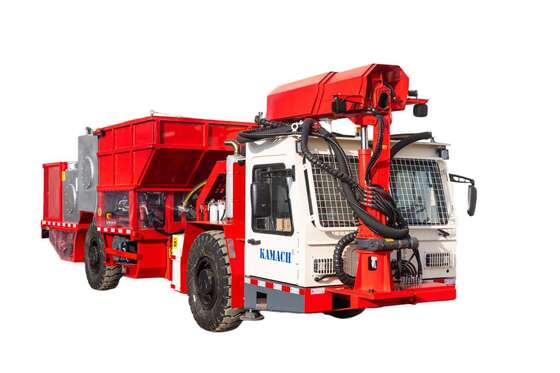
The KAMACH Dry Shotcrete Machine is a trackless, diesel/hydraulic-driven dry-mix shotcreting unit engineered for ground support and temporary / permanent rock reinforcement in underground hard-rock mines, tunnels and other underground excavations.
The machine continuously doses and conveys pre-mixed dry shotcrete (gunite) material — typically a dry blend of cement, aggregates (sand / crushed stone) and admixtures — through a rotary screw feeder, metering it at a controlled and repeatable output, then conveying it via compressed air through a shotcrete hose to the nozzle. At the nozzle, water and accerlerator is injected and mixed inline, and the plasticised mixture is propelled at high velocity onto the rock surface, forming a dense, high-strength reinforced concrete / shotcrete layer that provides immediate ground support.
The dry-mix process offers distinct advantages in remote, cold-region and low-ventilation headings: it uses simple, robust, low-maintenance equipment, tolerates wider variations in mix design, and allows long-distance conveying with minimal line clogging — making it particularly suited to development drivage, decline / ramp development, shaft sinking and narrow-vein operations where wet-mix logistics are impractical.
The KAMACH Dry Shotcrete Machine is a trackless, diesel/hydraulic-driven dry-mix shotcreting unit engineered for ground support and temporary / permanent rock reinforcement in underground hard-rock mines, tunnels and other underground excavations.
The machine continuously doses and conveys pre-mixed dry shotcrete (gunite) material — typically a dry blend of cement, aggregates (sand / crushed stone) and admixtures — through a rotary screw feeder, metering it at a controlled and repeatable output, then conveying it via compressed air through a shotcrete hose to the nozzle. At the nozzle, water and accerlerator is injected and mixed inline, and the plasticised mixture is propelled at high velocity onto the rock surface, forming a dense, high-strength reinforced concrete / shotcrete layer that provides immediate ground support.
The dry-mix process offers distinct advantages in remote, cold-region and low-ventilation headings: it uses simple, robust, low-maintenance equipment, tolerates wider variations in mix design, and allows long-distance conveying with minimal line clogging — making it particularly suited to development drivage, decline / ramp development, shaft sinking and narrow-vein operations where wet-mix logistics are impractical.